(NOTE: I try to title my posts with song titles, and since I don’t know any songs with “Rochambeau” in the title, you get some Wu.)
Mingus, one of our geriatric dogs, woke me up at 2am on Christmas morning to pee. After she came back in, I could not get back to sleep. For some reason, I was thinking about rock-paper-scissors.
And, yeah, this is about fighting.
I was coaching two students in a sparring session two days earlier. X, an older teen and a 1st dan black belt in taekwondo, has not been in class for a couple of months because of school and college applications. He also trains in hapkido and modern arnis. His preferred approach is to kick first, punch second, and avoid grappling at all costs.
B, in his early 20s, is quite consistent in attendance and a 4th dan black belt in taekwondo. He also trains in hapkido. His kicks are very very good and he is getting more comfortable with his punches. He has been working a lot on clinching and grappling during sparring, particularly in clinching to a couple of different judo throws.
As X and B were sparring Monday, B kept clinching X, who did a great job in basing, preventing the takedowns and throws that B was trying to execute. Finally, a student who was watching with me yelled, “B, pull guard!” And he did. And it was hilarious.
I think this episode raised the idea of rock-paper-scissors for me. I honestly don’t know if it’s original, so if you are aware of this metaphor being used by someone else in a martial arts or fighting context, I’d love to know about it.
It goes like this:
Imagine you, like X (or me, for that matter), prefer striking. You are a skilled striker, and striking is where you are most comfortable. You probably have the skills to defend yourself against a majority of potential untrained attackers. You do not like clinch, and you avoid training it for that reason.
Now, imagine you are like B. You are a skilled striker and are actively working on improving your standing grappling. You probably have the skills to defend yourself against a majority of potential untrained attackers. However, crucially, B is also actively developing skills to deal with a better striker.
If a skilled striker is rock, B’s developing clinch skills are paper. He has an answer for someone who is better than he is at his primary approach. This is not to say that X doesn’t have a paper to a good striker’s rock, but B might have more papers than X does.
Personally, where I am most comfortable is sort of a muay mat approach: heavy on punching and low kicks. That’s my rock. If I am attacked, I am most likely to initially respond with punches, teeps, and low kicks. However, if my attacker is a trained striker, my paper is standing grappling. So far, so good.
Now, what if my attacker has been training in judo, or has a couple of years in Brazilian jiu-jitsu and so has reasonably developed standing grappling skills? He has scissors for my paper. That’s ok. I need a new rock for an opponent who has an answer to my grappling ability. This might be short-range striking (elbows, knees to the leg), or maybe eye gouges.
Perhaps he has an answer for those techniques, too. Perhaps he takes me to the ground, and my rudimentary ground skills are not enough. Perhaps my scissors versus his ground-fighting paper is going to actual scissors (or another, more reasonable weapon). At some point, an opponent may have more answers than I do, but my goal should probably be to maximize how many responses I have, thereby minimizing the chances that any opponent in a violent encounter has the last, um, scissor, I guess.
I was talking to a friend last Saturday during sparring class about Ryan Hoover‘s idea of a second plan A. This is an important concept in fighting that I think will be familiar, though it is couched in unique terms. I do not want to speak for Ryan, so I will tell you how his concept resonates with me, and how that ties back to rock-paper-scissors.
Many of us find ourselves trying for a particular technique in sparring. That works out all right in a striking context: We can keep trying to get something to work in different contexts with different approaches and partners. This experimentation is an important way to learn, and in many ways is the point of sparring.
However, especially in a grappling context, we often get fixated on one particular technique, even after we know that technique will not work and that our partner has our number. “I MUST GET THIS OSOTOGARI!” Sparring can be a lot of different things, but at its root, it is practice fighting. It is better to move on (flow) to a new technique rather than forcing one that appears unlikely to be successful. I believe if I am comfortable doing that in a sparring context with a partner, I am more likely to pursue that approach in the context of violence with an opponent.
Where the concept of second plan A comes in is that a “plan B” has the connotation of being a sub-optimal solution that will only be tried reluctantly after plan A has failed. Instead of clinging to the “better” plan A to prevent being forced to the “lesser” plan B, the second plan A paradigm says, look, plan A is not viable. This might be because your opponent/partner read your plans and is pre-empting you. It might be because you blew an opportunity. It does not matter why: Your first plan A is gone. Your second plan A, and your current course of action, becomes what is available next, your best option in this new context. And so on, until you get to your nth plan A. Or knocked or choked out, I guess…
Changing my approach is not failure, it’s adaptation. How does this apply to rock-paper-scissors?
Thinking about fighting like rock-paper-scissors takes a person out of that rigidity that having a single, best plan A implies. It can make one intentionally proactive by reframing how they think about fighting. Fighting through a counter to get to one’s “plan A technique” is no longer appealing. Now, someone throwing paper on your rock just makes you look for scissors. It isn’t failing, not really; this is fighting iteratively, adaptively. This is not a new concept, but I find the rock-paper-scissor framing a useful metaphor that most people will intuitively grasp.
I have not pressure-tested this idea or really thought through it completely. However, writing it out has helped me clarify my thoughts regarding how to approach flow and my willingness to move on during sparring, regardless of the art and context. In talking through it with others, it appears to be easily grasped and helpful, and I will be using this idea in coaching sparring and in teaching hapkido. I’m gonna call it “The Rochambeau Principle.” What do you think of the name?
My next goal will be to develop a seminar on this topic. The trick will be, I think, to get the concept across without participants tying it to the specific techniques we might use to illustrate the concept, if that makes sense. It may not be possible but I’m going to take a run at it.
If I ripped this off from someone, please let me know who! If you find this idea useful, use it, refine it, make someone better with it, and let me know how you refine it so I can use your better version, too.
(Dear Reader: I strongly suggest you listen to this episode of the podcast Strong Songs before reading, both because he’s brilliant, and because it will give you context. Also, some of the song links below are to me, or my kids, performing songs, but I think most of them go to the original artists’ versions.)
Kirk,
I just saw that a bonus episode of Strong Songs dropped, so I clicked over. When I saw the title, I immediately listened, enraptured. You probably have received (and will continue to receive) an outpouring of not only sympathy, but missives like this one, describing just how deeply and personally the episode hit. This letter is a story of my family’s musical journey, and it doesn’t end in me being a professional musician or anything. But much of your story was strikingly similar to mine (and probably thousands of others), and honestly it wound up being an excuse to set this all down in one place.
I was listening to the episode as I waited in line, in the car, for the kids to come out of high school. They got in the car, headphones on. As soon as the episode was over, I switched over to Neko’s “Oracle of the Maritimes,” which, for my money, is her absolute masterpiece. Both kids, within the opening line, began singing along, taking off their headphones. And I of course teared up, because for us, too, music is a throughline, something that has linked our family across generations.
SIDE QUEST: The Top Five Masterpieces that illustrate the genius of Neko Case
5. “I Wish I Was the Moon,” Blacklisted
4. “Middle Cyclone,” Middle Cyclone
3. “Night Still Comes,” The Worse It Gets…
2. “Prison Girls,” Middle Cyclone
1. “Oracle of the Maritimes,” Hell-on
II. Where We Learn More About Papa’s Musical Past
I’m a 53-year-old father of two. My kids are 17 (Iain) and 15 (Jamie), and my dad (Bill, “Papa”) is almost 75. Last year, Iain had a school project in which he had to interview two people and write their biographies. He did mine first, then my dad’s. After he talked to my dad, Iain posted in our family Discord that my dad was in a band in high school (which I knew), that they recorded a single called “Just Call Me Up” (which I did not know), and that it EXISTS ON YOUTUBE. My dad was 15 at the time. Also, it kind of rules.
My dad played guitar when I was a kid. He always played the same few songs. He never sang when he played. He was strictly rhythm, in Knopfler’s words, and he will tell you that his job vocally was the scream in “Twist and Shout.” However, my dad worked, very hard, his entire life. One of the side effects of that is that he can no longer get his fretting hand into position to play guitar due to severe shoulder and neck issues. So he has, I don’t know, 15 guitars hanging in his basement, which only get played occasionally by Jamie or me.
At some point in the past several years, he had his childhood guitar repaired. It is a Gibson student model, hollow body electric, possibly an ES-120? He tells the story of taking it to a party, forgetting it, and going back for it to find that the neck had been broken at the heel. It was in two pieces throughout my childhood. He recently had the neck glued and he rewired the electronics. The action is a little high and its tuning isn’t all that stable, but it’s definitely playable. I have it now.
III. A Brief Diversion To My College Band
I played alto sax from 6th grade through my freshman year in college. I got my electric bass my freshman year and played in a band my junior year. We played mostly covers, though our guitarist wrote a few songs as well. I have an old VHS tape of us playing that my kids haven’t seen. I should get that digitized: While we have a VCR, I do not trust it to not eat such a valuable historical document. Yes, that’s sarcasm.
IV. My Performance History
I bought my first guitar my junior year in college for $50. It is a Gibson Melody Maker. It was black when I bought it, with very punk rock paint splatters all over it. Almost 20 years ago, I stripped the paint, routered the body and added a neck pickup, and wired it like a Les Paul. I stained it red and lacquered it. I love the 24” scale. It feels tiny. Since then, I’ve obtained a few other guitars: both a Squier and a Fender tele, a Dean Palomino hollowbody electric, a maple Washburn jumbo acoustic, a Cordoba classical, a Gibson Howard Roberts Fusion that my dad gave me, plus the old Guya Tone semi-hollow that was my dad’s guitar when I was a kid, and of course, his childhood guitar.
In 2003, we were living in Richmond, Virginia. Hurricane Isabel hit that September, and we didn’t have electricity for nine days. I sat downstairs where it was the coolest and broke the seal on singing and playing guitar at the same time, using that Melody Maker. No power, so no amp! The first two songs I learned to sing and play at the same time were “Time” by Tom Waits and “Looks,” as recorded by Mike Doughty.
After those first two, finding the melody and isolating the singing process from the guitar playing became easier. Very soon afterward, I traded my old beat-to-shit Bundy II alto for a pretty cheap Takamine acoustic. Iain’s first vocal performance was accompanied by that guitar, as he sang “Astro Zombies” by The Misfits at about 18 months old. I later traded that Takamine for the Washburn that I still have.
A few years after Iain’s video debut, I began playing an open mic at a local pizza joint. I play under the name Brother Doyle, which is how my grandfather always referred to his brother—never just “Doyle,” always “Brother Doyle.” The internet makes it easy to find the chords for pretty much any song, though they often aren’t quite correct. I was taking songs I knew and loved and arranging them for acoustic guitar. Well, “arranging” is strong. “Simplified” is a better term. I’m not much of a guitar player and the extent of my soloing ability is the five-note ending of “Cactus” by the Pixies. I did learn to finger pick a little (“Perfect Disguise” by Modest Mouse, “(Let’s Not Pretend to be) New Men” by Crooked Fingers, “Lungs” by Townes van Zandt, and a version of “Diamonds and Gold” by Tom Waits), and I loved playing in front of the very very small crowds.
Then, we built the studio. The studio is a climate-controlled, 25×12 room in my garage that I expressly built so I could play at night while the kids were in bed. I bought a drum kit, and a decent keyboard. I rebuilt my PA speakers from when I was a DJ in college and used them for the sound system. It’s one of the best things I’ve ever done.
Once a year, we have what we call the open house: It’s a fall party in early October. Drinks, food, camping, fire. For several years, I played a set in the studio for anyone that wanted to listen. It was the only time each year I played for people. The songs were often the same, though I tried to add a few new ones every year. I always ended with “Age of Consent” by New Order, and I always sang an a capella version of Tom Waits’s “Gun St. Girl,” which took some nerves and intestinal fortitude.
However, in the past few years, my genetic predisposition to osteoarthritis has been raising its evil head, and it makes it hard to play. I’ve dabbled with learning piano but it’s frustrating, compared to guitar. So I haven’t played at the open house in two years, and I won’t this year, and it kills me.
SIDE QUEST: My Top Five Favorite Songs to Play and Sing
5. “Pocahontas,” Neil Young
4. “Cactus,” Pixies
3. “Alison,” Elvis Costello
2. “Lungs,” Townes van Zandt
1. “Age of Consent/Temptation,” New Order
Side note: I’ve recently cut out much of the sugar in my diet, and it seems to be helping with my arthritis. I’m hopeful for a Brother Doyle de-retirement performance at the open house in October 2026.
The last time I played, two years ago, I played my dad’s old Gibson for a song. The song was “Jack the Ripper” by Nick Cave and the Bad Seeds, a straight-up blues in G. It was a perfect fit.
V. My Kids And Music
So my kids grew up, listening to music in the car everywhere we went, hearing me play guitar and singing around the house, just like me hearing my mom sing constantly when I was a kid. I was only barely careful when selecting what to listen to in the car, as the following brief anecdotes will reflect.
Iain, at age 3:
Iain (As New Order’s “Age of Consent” comes on): After this song, can we listen to “Martian Walk”?
Me: “Martian Rock”? I don’t know that one.
Iain: Yes you do, remember, we listened to it before. “Martian WALK.”
Me: Sorry, Bug, I have no idea…
Iain: It’s rock ‘n’ roll all the way through, remember?
Me: OH! “MARGIN WALKER!” Yeah, we can listen to “Margin Walker” next.
Iain, maybe a year before that: “Is the man making noise? THE MAN IS MAKING NOIIIISE!” (Charles Mingus, “II BS”)
Jamie, sad in the back seat. “What’s wrong?” “I miss the ‘nobody but us’ song.” (He was 3 years old, and was sad because he wanted to hear “Miss Gradenko” by The Police but didn’t have the words to ask.)
Home on a Friday with Jamie, age 4 or 5, Iain at school. I heard the same song coming from his little CD player boom box in his room, over and over and over. I went in and asked what he was doing. “I’m a DJ!” The song he was playing over and over was “(White Man) In Hammersmith Palais” by The Clash.
And this one. This is a story I’ve told a hundred times, one I’ve probably even told you, Kirk, in some email I’ve sent you over the years. I was sitting in a hotel in Mobile, Alabama, in July of (I think) 2011. I was at a work meeting, having breakfast with some colleagues. My wife Melissa called and said Iain had something he wanted to tell me. Iain got on the phone and sang “Web In Front” by Archers of Loaf, all the way through. I had to get up quickly and leave the room because I was bawling like a baby. Here he is, singing it a few months later (I think).
Jamie, playing guitar and singing “Holland 1945” by Neutral Milk Hotel at the open house two years ago. When he was still learning piano instead of guitar, we used to play together—I would sing and play guitar while he played piano. Here we are, playing “On the Radio” by Regina Spektor together (I’m not playing, just singing). Side note: watch this live version of Regina playing this song. Or a more stripped-down version. Sweet Jesus. Her voice just pulls tears out of me.
Last one. Iain, now 17, spent a week this summer at a college, taking a course on writing for, and how to exist at, college. His weeklong assignment (which he essentially ignored) was to write an analysis of a music video. He chose one of his favorite songs, “Cult of Personality” by Living Colour. All Iain has wanted to be since he was about 6 is a history professor. He wrote several pages on the historical context of the leaders mentioned in the song, not even getting past the first verse, before the professor told him to quit there, he had written more than enough. At the end of the session, in the presentation for parents, he essentially railed for 10 minutes about how none of the leaders, not JFK, MLK, or Ghandhi, were worthy of the admiration they received through their cults of personality. I still don’t know if he ever even looked at the video…definitely a proud dad moment.
VI. Can I Pull This All Together?
I was recently talking, via e-mail, with a friend who lives in South Africa. We met in Scotland in 1995, and have not seen each other since. We were discussing how sometimes it’s very difficult to know what you mean to another person, whether those who are important to you reciprocate the feeling, and how our actions are felt, seen, and remembered by others. This all came up well after I started writing this letter, but in reflecting back on why I felt it is so important to write this, I think that’s part of it. I think it’s important for you to hear how your story resonated with me, how your family’s experiences were similar to mine. Your story really touched me and you should know that.
Thank you for what you do. If you find yourself in Bloomington in early October, ANY early October, you’re perpetually invited to the open house. And if you’re in Bloomington any other time, give a shout and come on down. I’ll show you the studio.
Take care.
Adam
Filed under: Uncategorized | Tags: books, fantasy, florilegia, reading, sparklets, stephen-king
(I usually pick a relevant song title for my post title. I couldn’t think of one. So I grabbed a Dark Tower sparklet that seemed particularly apropos.)
On 2 February 2020 I started a read-through of Stephen King’s The Dark Tower series. You may be putting together that the date I began this particular journey was about one month before the world moved on (to lockdown and pandemic). On 3 January 2025 I finished the final book, The Dark Tower. The purpose of this read-through was to gather florilegia, or sparklets.
I learned of this practice through the podcast Harry Potter and the Sacred Text, hosted by Vanessa Zoltan and Casper ter Kuile. (As an aside, I just learned that, after completing this entire series, Vanessa Zoltan went back through the entire series with a different co-host! Insane! So I was inspired by Series 1 and have not listened to Series 2). Our hosts used several different traditions to deep-read the Harry Potter books as a sacred text. The most intriguing to me was the use of sparklets. Sparklets, or florilegia, are explained by Vanessa here. Essentially, the reader pulls out words, phrases, or sentences from the text that strike them as important, beautiful, or that otherwise “sparkle.” Those sparklets can then be read as their own sacred text.
In the spirit of full disclosure, I actually think that the Harry Potter books are not very good. I like the story and the world, but I think the writing is sloppy and the plot is at the very least inconsistent (how can a permission slip possibly be required for a visit to town but not to play quidditch??!). And yes, I thought this about the books before we found out that Rowling is a terrible person.
In listening to the podcast, mostly with my kids, I started to think about what books I would like to treat to such a deep read. I am an atheist but the idea of sacredness is fascinating to me. I do not believe that a thing must be divine to be sacred. Vonnegut famously said that Armistice Day was sacred and Veteran’s Day is not. As The Hold Steady says,
There’s gonna come a time when the true scene leaders
Forget where they differ and get big picture
’cause the kids at their shows, they’ll have kids of their own
The sing-a-long songs will be our scriptures
(Side note: As one of the former kids at the shows who now has kids of their own, I have been threatening for years to compile a book of sacred lyrics. Imagine a Book of Joe (Strummer), a Book of Elvis (Costello), a Book of Billy (Bragg), a Book of Eric (Bachmann), a Book of Tom (Waits), a book of Neko (Case), and a Book of Bruce (Springsteen). But that is a project that will have to wait, like so many others. So it goes.)
So what book could I choose? What book or books mean enough to me that it could stand up to that kind of deep read, that kind of scrutiny? I read a fair bit, and there might be others that I could do (Patrick Rothfuss, if you ever finish The Doors of Stone, I would definitely read The Kingkiller Chronicles this way), but only one series stood out as obvious: King’s The Dark Tower.
The Dark Tower is the story of the last gunslinger, Roland Deschain of Gilead, and his quest for the Dark Tower across a world that has moved on. The first book, The Gunslinger, was one of the first novels King wrote. First published as a novel in 1982, The Gunslinger took five previously published short stories and put them together. It is very different from his other work, the language being much sparser. When I first read it as a teen, I did not like it at all. King revised the book and re-published it in 2003, making it more consistent with the six novels that followed.
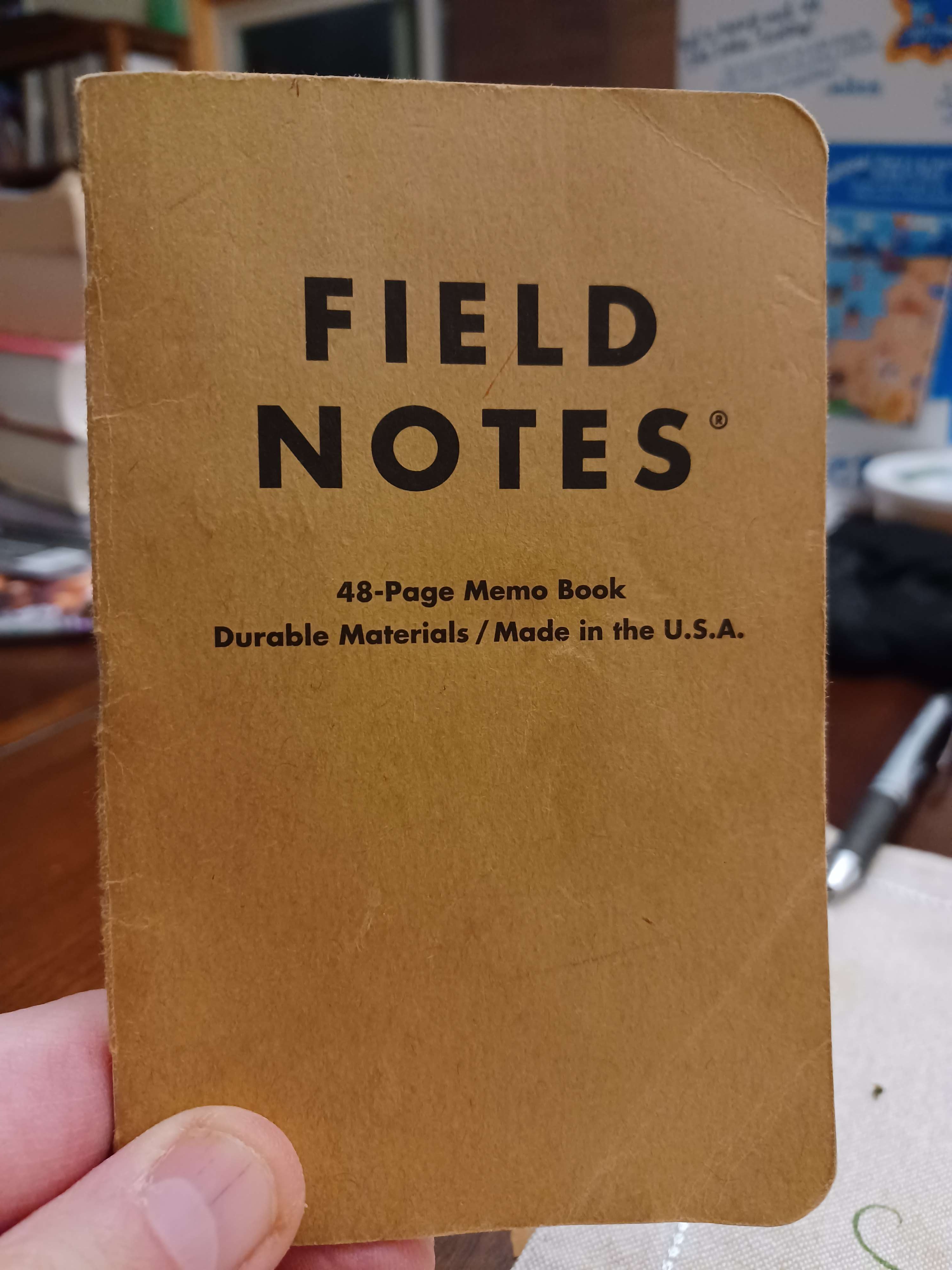
From February 2020 to January 2025, I exactly filled this Field Notes memo book with sparklets of text that I found compelling. I took a few long breaks in there, and I read lots and lots of other books in between. The first long break occurred in late 2020 into early 2021, when the darkness of The Waste Lands (book 3), in concurrence with the world at the time (COVID-19, American fascism), was negatively affecting my sleep and dreams. As I said to a friend at the time, “It’s hard to go into Lud when you know what is there.”
I took another break during book 4, Wizard and Glass. It’s my favorite book of the series, but, well, I know how it ends and I postponed that inevitability for a while. Charyou tree.
When the reading was finished, I entered all of the florilegia into a spreadsheet. Each book has its own sheet, with all of the sparklets concatenated in the last sheet. There are a total of 546 snippets of text. Most are phrases of a few words, though some are full sentences and a few are multiple sentences in length. Each is numbered in order so that I can return to the original order in which they occur in the text when I want to.
I then assigned each a random number and sorted by that number. I wanted to see how they would recombine randomly. I looked at this randomized list before I spent much time with the list in the original order. I had a thought, vaguely, that this integration of florilegia with the cut-up method of William S. Burroughs might produce something interesting, maybe even inspirational. Maybe poetry? Possibly even lyrics?
What I found astounded me, honestly. My first attempt to derive meaning, or at least comprehensiveness, resulted in this:
That was when you died / A study in severe blacks and whites / Guileless and dismayed / Truth is sometimes not the same as reality
To get this one, I let my eyes skim. They settled on the first line, followed immediately by the next two. Then I skipped over the next two lines to find the fourth line. So this little snippet of poetry, four lines, represents six lines of my spreadsheet. I think this first one that I found is among the very best so far.
I went back to the top and started at the very first line:
The amusement of a lunatic / A pleasing sense of redemption / Cozy as the devil / If that puzzles you / As though I’d lost gravity / For every hand stayed from violence / Wolves of a kind / An arduous party / The unconscious distaste of the ascetic
This represents the first 14 lines of the randomized list, skipping 5 lines in between that didn’t seem to fit. I found when writing this one that sometimes the sparklets work better in concert with the others with slight changes. “Pleasing sense of redemption” became “A pleasing sense of redemption.” If I take those lines and play with the structure a little, I get
The amusement of a lunatic–
A pleasing sense of redemption, cozy as the devil.
If that puzzles you, as though I’d lost gravity,
For every hand stayed from violence–
Wolves of a kind, an arduous party:
The unconscious distaste of the ascetic.
That feels like a poem. Is it a poem? Sure. I guess.
Some of the combinations truly feel like song lyrics. I play guitar, but I’ve never written a song. I wonder if sai King will sue me if I use these sparklets to write my first? Like this one. These four lines followed one another directly! It doesn’t seem possible that it’s random (but of course it is). I made one small change to the first line (changed the “could” to “can”) and another to the last (made it present tense, from the original “was it any wonder that wonder had run out?”).
Memory can be bashful / It is the voice of the Turtle / Tell me, for your Father’s sake / Is it any wonder that wonder has run out?
Some of the lines and combinations are clearly detectable as lines from The Dark Tower:
Depthless eyes / Wonders and miracles / The boy found the oracle and it almost destroyed him / A short but undeniably interesting life
To get that one, I had to skip over the lines from the previous grouping, but the last two lines randomly appeared together—a remarkably good pairing, do ya kennit? Other combinations seem to channel those who seem to have been inspired by the series, forming a potential closed loop of inspiration. For example, the following could be Nick Cave lyrics:
The unhappy wisdom of unhappy children / That prescient part of him / “I come unarmed and mean no ill” / But voices screeched and hollered / And a quicksilver shimmer / Rose up righteous
Or this one, that could be Tom Waits. I had to play with the structure, combining two lines into one a couple of times, but it reads brilliantly:
Almost untethered from the world
My very words, burned by her regard
The ageless stranger won’t worry that old knot
He must go on alone
The antithesis of emotion
The last time pays for all: These are memories he denies.
And I’ll end here, with sai King commenting unwillingly, out of context, and out of order upon our current state of affairs: Fascism, cruelty, and fear ascendent in the land.
It is the custom of this country: Relentless unmeaning cruelty.
The word degenerated, bitter as tears,
Like the world upon whose hide he walked.
It feels like I did a thing, even though I don’t know what it accomplished. I will continue mining this source and finding new meanings. I will look for combinations of meaning in the original order, and I may even continue re-randomizing them to find new ones over time.
Anyway, this trip through the waste lands to the Tower is done. It’s never easy. You say true, I say thankya.
I was choring in the garden today. I generally listen to audiobooks in my earbuds while I work out there, but I turned my current book off today and put on a new playlist I just made yesterday (“El Rock Clásico”) instead. I don’t listen to a lot of classic rock (except I guess sort of everything I listen to is classic rock, if you consider its age…) but this playlist has a bunch of music that’s a bit more obscure. It’s all music that I liked when I was a teen and I wanted to see how much of it held up for me. Immediately cut from the list, for instance, halfway through each song, were “Badge” by Cream and “Conquistador” by Procol Harum.
However, this post was inspired by a song I have always loved that is pretty far outside my usual wheelhouse: “The Low Spark of High-heeled Boys,” by Traffic (1971–it came out one year before I did). This is a long song, decent lyrics, weird chorus. I’ll come back to it.
- Ugly Music
I’ve always loved what I call ugly music. It can be songs with “normal” structure and harmony/melody that just has ugly lyrics (Neko Case is so good at tackling ugly issues in gorgeous songs, like “Last Lion of Albion”), but usually I am referring to music that is noisy, dissonant, and powerfully delivered. The song I always use as an example of my musical taste is “Fabricoh,” by Archers of Loaf . What is it about the chaos and dissonance of these songs that I love? Presumably there are a lot of us who prefer this sort of music, even if we are a minority.
My musical tastes are pretty wide, though, and I can find ugly music anywhere. The preference even translates to jazz. Here are other good examples.
“Do You Like Me?” by Fugazi
“Jesus Christ Pose” by Soundgarden (Chris Cornell’s VOICE! Kim Thayil’s GUITAR! Has anyone ever been more 90s Seattle than Cornell in this video? No. No they haven’t.)
“Queenie” by Ethyl Meatplow (Emphatically NOT safe for work, language-wise. Carla Bozulich’s voice though, ye gods.)
“I Drown” by Barkmarket (If I ever get a speeding ticket I’ll be listening to this song at the time.)
“Tango til They’re Sore” by Tom Waits (To be played at my funeral. That piano at the beginning is so jangly and dissonant but strangely beautiful and harmonically appropriate.)
“Duet Solo Dancers” by Charles Mingus (Just. Whoa.)
“My Favorite Things” by John Coltrane (Trane’s flights of fancy on this one are otherworldly.)
- Frisson
I also experience frisson, which is the phenomenon of getting chills or goosebumps while listening to music. While I usually see this described as happening during beautiful music, but for me it happens during powerful music. I believe the response of unintentional tearing up or crying during music is related to frisson, though I can’t necessarily find a reference to bear that out (but see here for a study that examined both). I know I’ve told the story before of having to pull my truck over, pretty much crying uncontrollably, because a song came on that overwhelmed me with its beauty and power—the live version of Superchunk’s “Slack Motherfucker,” performed by fIREHOSE.
For another example, I was just scouting the Charles Mingus I wanted to include here and my wife asked me what it was. I just said, “Mingus,” and my jaw dropped open unintentionally and my eyes started watering.
Good stuff.
I’m actually not sure how related this is, but there are songs that I know how to play and sing that I literally cannot play in front of people because I start crying every time. Maybe I’m just unhinged.
- And Now, Traffic
So when you get all the way to the end of “Low Spark” (the 11:00 mark), there’s this unglued, fuzzed out guitar solo. You might even convince me that it was a saxophone or other horn run through a fuzz effect because of the way it’s articulated, except for the chords. A saxophone can’t play chords! But the song ends with two completely dissonant chord voicings that do not seem to fit. The first one holds for a minute and you’re like, goddamn, what is he DOING, then it resolves to something even more out of whack with the harmony of the song. It hits, my jaw drops open, and my eyes water. Every time. I know it’s coming and it still hits me like a freight train. It’s masterful.
That’s it. Surprising no one, I like ugly music that a lot of people find annoying.
Filed under: Uncategorized
Below is the essay I wrote in partial fulfillment of the requirements for 3rd Dan rank in taekwondo at Lee’s Martial Arts, Bloomington.
===============================
I have experienced two relatively major changes since my Second Dan test in October 2020: I began training in two additional arts at Guardian Martial Arts that month, and I contracted COVID-19 in January 2022.
My COVID bout was relatively mild, but it has lingered in two ways. It has exacerbated the arthritis in my hands such that I experience what can only be described as chronic pain, primarily in my fingers. In addition, my hips are far more susceptible to pain than they were pre-COVID. This has functioned to reduce the stretching I am able to do and my range of motion. In taekwondo terms, my kicks, especially kicks that require turning over of the hip, have deteriorated. I can no longer side kick to the face of most opponents (an unnecessary and impractical technique for the most part, anyway). I also experience more joint pain in other areas: my knees stay sore longer and my shoulders are problematic. I suspect that I have arthritis in some of these joints as well (especially hips), but I have not sought a diagnosis. I don’t think I want to know. I know that some of this sounds like simply growing older, but the fact is that these problems turned on like a switch post-COVID.
On a brighter note, broadening my scope of training has been fantastic. I started the Natural Spirit International (NSI)/Worden Defense System branch of Modern Arnis. This includes stick, staff, and knife fighting techniques, combined with jeet kune do and hapkido-related empty hand skills. As part of that curriculum, we spend one hour a week in rules-based Muay Thai training and sparring. Muay Thai is far more directly applicable to hapkido than I would ever have thought, particularly dealing with grappling (clinch), kick defense, and takedowns, and of course taekwondo kicks have a strong place in kickboxing. One of my mantras has become, “The human body can only move in so many ways,” so the commonalities of these arts, and the way techniques bleed across (artificial) boundaries, make it more difficult every day to think about any single “pure” art. Thinking about martial arts, fighting arts, as a continuum that all inform one another, is much more constructive for me as I learn what works the best for me. My mindset, my body (physical strengths and limitations), all help me determine my style. I maintain a strong space for the tradition of each art, but in practicality, I pick and choose and integrate to augment my strengths and minimize my weaknesses.
Since my last taekwondo test, my skills, as strictly defined by the ability to physically perform specific taekwondo techniques, have doubtlessly declined. However, my overall ability as a martial artist has increased. I think better, I strategize better, I choose tactics better, and I do a better job of integrating useful techniques across arts. I do a much better job of focusing on concepts and applying them, rather than collecting individual techniques (though there is still massive room for improvement in my conceptual thinking). Focusing on concepts allows me to be resilient regardless of situation. Ranged striking, standing grappling, and ground fighting each require different approaches, but many of the concepts are the same. Range, moving oneself, moving one’s opponent, breathing, framing, and finding strong versus weak positions—these concepts are universal in martial arts.
So I train. I train about 11 hours a week, 8 of it at Lee’s. I teach two classes every week, one to a squirrelly beginner class, and one to a focused advanced class. Teaching, as I have said numerous times, is the greatest gift Lee’s has given me. It scratches an itch I couldn’t satisfy in any other way. And it has built my knowledge and understanding of taekwondo (and martial arts in general) in ways that only training cannot do. I have addressed these ideas before and will not reiterate them here. It does cost me training time (I rarely work out with the beginner class anymore, since I have found they need more guidance than I can provide if I do not watch them closely), but I truly think it makes me a stronger martial artist to teach. And I love it. Wednesday is my favorite (and longest) day of the week.
Finally, I have said in these papers before how important forms are in taekwondo; how I feel they are the grammar of the art and without them, the concepts of combinations and flow are more difficult to understand. I still think that is true. However, I also have come to believe that the higher one’s rank, the less important forms become. By Second Dan, the understanding of combinations should be well (if never fully) formed. Practicing forms is still crucial: the tradition, the control, the centering, the breathing, the awareness all remains important. However, I have come to think that, at higher ranks, forms become more of a means of self-expression than routines that are critical to learn by rote. I recognize that I am probably in the minority on this, and I am okay with that.
I have pushed in some ways that, in the moment, definitely feel like overstepping my bounds. I pushed to bring weapons into hapkido when we were all uncomfortable with heavy contact immediately post-COVID. I pushed to bring contact back to hapkido not long after that. And more recently, I pushed to start a sparring class for black belts (primarily; lower hapkido students also participate). The control that one must learn to spar safely is critical; that, together with learning to get hit and not give up are two pieces that I think are truly important in the martial arts in general. I am gratified that these classes are going well. I hope to continue to be able to help students who choose to participate think about how to integrate techniques across arts to develop their own fighting style.
I never quite know what you, The Reader, wants to see in these papers. I use them as an opportunity to provide you with a snapshot of where I am as a martial artist, how my thought has developed, since my last one. I hope that my newfound physical limitations do not prevent me from further development as a leader in our school (and maybe they will improve, who knows?). I believe that the Masters and Grandmasters understand that I am available to help in any way I can, and that opportunities to provide leadership are welcomed by me. I appreciate this place and I look forward to the future.
Filed under: Uncategorized
“To be played at maximum volume.”
So it states on the back of the greatest rock ‘n’ roll album ever recorded: The Rise and Fall of Ziggy Stardust and the Spiders From Mars, by David Bowie. I have thought about this record as a single (and singular) piece of art for well over a decade, and today, on Easter Sunday, 2020, I will extoll the virtues of this singularly messianic rock ‘n’ roll odyssey.
I will stress here that this is my interpretation of this record. I have no idea how close it is to what Bowie had in mind. I will add storyline to some songs that clearly isn’t there in the lyrics, but makes sense, based on the timeline and what I think the story is. I would dearly love to hear what you think.
Side 1, Track 1. “Five Years.”
In “Five Years,” we learn of a corrupt and intolerant world. A cop kisses the feet of a priest. A woman beats some children nearly to death. The main point of the song is that a man on the television tells us that the earth has just five years to live. But live goes on: Our narrator (whom I call John, for reasons I’ll get to), sees a girl he is in love with in an ice cream parlor, and uses the news of impending doom to approach her. We’ve only got five years, after all: Let’s make the most of it.
Side 1, Track 2. “Soul Love.”
The song opens with John’s mother at the grave of her son, John’s brother, Tony, who was killed during the occupation of Northern Ireland, “The Troubles”. Tony was in the British Army. Elsewhere, John and his new love (who remains unnamed–let’s call her Lori) are getting to know one another. John tells Lori about the band he is trying to start with his friends Weird and Gilly, the Spiders From Mars. So forms the relationship between John and Lori, and so begin The Spiders From Mars.
Side 1, Track 3. “Moonage Daydream.”
What is this? John, unable to sleep, thinking of Lori, is listening to pirate radio. Suddenly, the transmission is interrupted! Is…is this REALLY someone from space, broadcasting to Earth? Is that possible? And if so, what can it mean? Now really unable to sleep, he calls the only person he can, the only other person awake at this hour: His best friend, Weird.
Side 1, Track 4: “Starman.”
John describes what he heard to Weird. Weird, of course, heard it too! They discuss what it could possibly mean. The Starman wants to come to Earth, but he’s afraid that he will blow everyone’s minds. Apparently, though, he has overcome his concern, because they can see his ship sparkling in the sky, and they think he’s coming! Let the children boogie.
Side 1, Track 5: “It Ain’t Easy.”
Interestingly, the lyrics for only this song do not appear in the LP liner notes; the rest are all there. This song does not have an obvious narrative link to the story Bowie is telling. It could be that it was a track to fill out the side, not intended to have a place in the saga (which is why the lyrics are missing?). It could be that it’s the interlude, while John and Weird look for the Starman. I think it’s something darker. I think it’s a side story of Lori, meeting the Starman before John and Weird find him. The line “It ain’t easy to get to heaven when you’re going down” foreshadows an unreleased track from the Ziggy sessions: “Sweet Head.” I’ll come back to that one. I think that Lori meets the Starman and, cheating on John, gives him a blowjob. This sets the tone and foreshadows the eventual downfall of The Spiders From Mars.
Side 2, Track 1: “Lady Stardust.”
Here, in one of the great rock ballads of all time, The Spiders From Mars meet the Starman. During the Spiders’ first gig, a stranger jumps up on stage with a left-handed guitar and takes the mic. Of course, he’s not a stranger to Lori, in the crowd. Playing on the androgyny of the character, the Starman is identified as “Lady Stardust.” He is the piece the band was missing: the charisma and power. John still doesn’t know his name, but here, the Starman, Ziggy Stardust, and The Spiders From Mars are cemented together for all of history.
Side 2, Track 2: “Star.”
After the gig with Ziggy, The Spiders are taking off. Offers are coming in from everywhere. John mentions his dead brother, Tony, in the first line. Perhaps he is fighting with his parents as The Spiders head off on tour, bound for stardom.
Side 2, Track 3: “Hold On To Yourself.”
Here we see into the growing ego and mind of Ziggy. To himself, he is thinking about seeing Lori, his friend John’s girlfriend, at the gig tonight. Then, aloud, he says to his friends, his disciples: The Spiders: “We really got a good thing going…you better hang on to yourself.”
Here, after eight tracks, we diverge from the album as released. Here we must insert two unreleased tracks, tracks that are at the end of the Ryko release of this album and tracks that are critical to my understanding of this story.
Sidebar 1: “John I’m Only Dancing.”
This song is why I call the narrator John. John is becoming suspicious of Lori and Ziggy. He catches them dancing. Ziggy protests, “She turns me on, but I’m only dancing.” His suspicion hurts Ziggy. Is that why he allows things to go too far?…
Sidebar 2: “Sweet Head.”
After the accusations of the last song, Ziggy and Lori continue their tryst. Ziggy protests that he tried to break away from her, but it isn’t clear that he did. In the end, he feels that he deserves what he gets from Lori. John, of course, finds out.
Now, back to the album tracks.
Side 2, Track 4: “Ziggy Stardust.”
With Ziggy’s ego out of control and sleeping with Lori, John makes the decision to break up the band in one of the great epic rock tracks of all time. The crowd at the gig finds out what happened and they turn on Ziggy. In the ensuing riot, Ziggy is killed. Or at least, it seems he is. His body is never found.
Side 2, Track 5: “Suffragette City.”
Having broken up the band and left Lori, John is a mess. He’s sleeping with anyone who will have him. At a nightclub with the band’s manager, Henry, John is doing all he can to pick up women, telling Henry to go sit somewhere else, because “…there’s only room for one, and here she comes!”
Side 2, Track 6: “Rock ‘n’ Roll Suicide.”
The hard living has gotten to John, worn him down. He is out of touch with Weird and Gilly, his only friends, since his relationship with Lori cost them their livelihood. As he stumbles around London, alone and beaten, who should he find?
Lori.
After John is nearly killed by a car in the road, Lori follows him home. She tells him he is not alone. She stays with him. They call Weird. They call Gilly. They all gather, the four of them, what is left of Ziggy’s disciples, and wait. The world is ending, but they are not alone.
Postscript: I try to make this into a messianic story, wherein Ziggy’s death saves the world. But the deeper I look, I don’t see it. What I see is Ziggy, seeing what he has done to his friend John, sacrificing himself (returning to his home?) so that John can be happy with Lori. The world is still ending, I think, but John, having been prevented from becoming a rock ‘n’ roll suicide by Ziggy’s sacrifice and Lori’s love, faces it with his friends.
I try really hard not to think about the lessons we can take from this in the world of today.
Filed under: Uncategorized

One of the requirements to test for a black belt at our school is a 500 word paper on what martial arts means to me. I don’t yet know when I am testing (I’m still holding out hope for 12 October), but I’ve written this twice, sat with this version for a couple of weeks, and this will be what I submit. Thanks for reading.
============================================================================
I have settled on explaining some of the things I have learned through training. By doing so, I hope that I am able to paint a picture of what my training has meant to me in a way I am having trouble doing directly. I hope that it meets your expectations.
In my tae kwon do training, I have learned that one’s mind wants to quit well before one’s body is actually incapable of continuing. Once one comes to that realization, what is physically possible expands a great deal.
I have learned that forms are the grammar of the art. They do not teach us the only ways techniques can be combined, but they construct a list of examples that the martial artist can call on to create their own unique combinations. They open our eyes to how techniques flow together. They teach us to put words into sentences.
I have learned that I am a good teacher, and that I love teaching. I hope I can contribute in that way to our school. I am keeping a notebook on different aspects of different instructional techniques that I like, and new ideas that I want to incorporate when teaching my own classes.
I have learned that teaching someone else how to execute a complex technique or a form makes my own stronger, as I must drill down and take apart how I do it before I can teach it. I have also learned that, once a student has the technique broken down, repetition is the key to learning, to ingraining technique into muscle memory. I have learned, therefore, that teaching is a critical component of being a martial artist.
I have learned that slow is smooth, and smooth is fast.
I have learned that I can collaborate with higher belts, and we can both learn something. I have learned that I can collaborate with lower belts, and we can both learn something. Humility and confidence are two equally important sides of this coin: One can learn from those of lower rank as well as from those of higher rank, and each student has something to offer other students.
I have learned that training one’s body to perform in ways that were not thought possible does amazing things for one’s confidence. I have learned that there are techniques that I will likely never be able to do well. I have learned that even these extremely demanding techniques improve with repetition. I have learned that maybe the most important way that tae kwon do assists with self-defense is by developing confidence. That confidence lets one stand up for one’s self. It is also obvious and seen by others, so it can prevent conflict before it starts.
I have learned that the stress of pushing one’s mind and body can cause unexpected emotional responses. I expect that this happens more often than we realize (or maybe just more often than we admit).
I have learned that respect goes both ways: A black belt must respect lower belts just as lower belts must respect those who outrank them.
I have learned that control is one of our most important tenets. Control prevents the student from injuring others. Control prevents the student from injuring themselves. Control is integral to proper technique: Control of body (movement), control of mind (tenacity, temper).
I have learned how gratifying it is to share an interest with my family. I have learned how gratifying it is to make new friends based on this shared interest. I have learned that the support of other students helps all of us excel, makes it easier to excel, and makes me want to excel. One of my favorite aspects of participating in martial arts is watching my fellow students improve and excel.
I look forward to the opportunity to be a leader in our school. Thank you.
Filed under: Uncategorized
A thing happened to me during hapkido class last night that has never happened to me before. It’s not much of a story, really, but I’m telling it as an excuse to tell a different story, one that I’ve struggled with whether and how to tell for a couple of months.
I.
Hapkido is, as you probably know, a Korean martial art that focuses on self-defense methods (how to hurt someone who is trying to hurt you). This is in contrast to the more famous Korean art of tae kwon do, which tends to be more sport-oriented (think sparring rather than true fighting, though there are certainly powerful techniques taught in tae kwon do!). In hapkido, we practice joint locks, punch and kick defenses, throws, defense against various weapons, and chokes. I have been attending 2-3 hapkido classes a week for about two years, and hold a blue belt. Our belt progression is
white – yellow – orange – green – purple – blue – brown – red – red/black – black,
so I guess I consider myself in the middle of the intermediate range, at least for a colored belt. It is often said that one doesn’t truly begin to learn a martial art until one reaches black belt, so there are differing perspectives. As a blue belt, I think I’m starting to feel the flow of hapkido (finally!), which means that transitions between techniques are coming a little easier. Overall, it is a much more difficult, more…subjective…art than tae kwon do, and therefore, more frustrating. But I think I’m getting it.
Hapkido classes are generally small. One reason is that our school does not teach hapkido to students younger than 18. This is to prevent growing joints from being damaged, and from putting potentially lethal self-defense techniques into the hands of children. Another reason that classes are small is that it hurts to learn hapkido. In order to practice joint locks and throws, one takes turns applying techniques to others, then having them applied. Joint locks hurt. Being thrown sucks. But being thrown and locked is how we learn the techniques, as well as how to fall safely (not to mention how to counter these techniques). At any rate, the pain and discomfort of the techniques tends to limit practitioners to those who really want to learn, and our dropout rate is quite high. Since I have been at this school (almost three years), I have seen many tae kwon do black belt tests, but not a single hapkido black belt test.
Currently, we have two 2nd dan black belts, 2 brown belts, a blue belt, two orange belts, and a white belt who regularly attend hapkido classes. Frequently there are only two of us in any given class. The biggest class I’ve ever been in was 6.
II.
Not long after earning my blue belt in April, on a Monday night, I was working with the 2nd dan black belt who usually attends on Mondays. He was beating my ass as usual. He is a big guy, a little older than me, I guess, and his knowledge of hapkido can only be described as encyclopedic: various interesting and painful joint lock variations, new ways to toss someone around, and especially how to use pressure points. I learn a tremendous amount from him every single time we work out together. He is a big part of the reason I have the small amount of proficiency I have.
On the night in question, I took him to the ground to get out of a lock. To say that ground work is not my forte’ is a gross understatement. I am uncomfortable on the ground because I lack proficiency and it tends to be very claustrophobic. I can hold my own against some opponents, but I am just totally outclassed against our black belts. We had gone to the ground several times that evening. In this instance we went to the ground, and after a minute or so I tapped out (as always). I got up, put my hands behind my head, and walked away. The Master was asking if I was all right: Was I injured, gassed, or what? I was not facing them, and couldn’t answer him because I didn’t trust my voice not to break. I was…not crying, exactly, but in tears.
After 30 seconds I realized I couldn’t get it under control and I just turned around to face them and said, “I’m fine. I’m pissed. I’m sorry,” I added to my partner, who said, “That’s all right.” The Master asked, “Frustrated?” and I said yeah.
But I didn’t feel frustrated. I felt pissed. I was pissed because I was on the ground, getting my ass beat. I was pissed because I had just been there a few minutes ago, with the same results. And yes, some of that is frustration: Being angry with myself because I couldn’t do anything to better my situation. But I think that part of me in the moment was just thinking, “Goddamn it, man, you’re way better than me, you’re on top of me, maybe hitting my facial pressure points isn’t really necessary.”
Now, understand: I bear him no ill will. I respect and admire him and I count him as a friend. But in that moment, yes, I was angry. And I don’t have an easy time controlling my emotions at the best of times.
(I was driving in my truck once, and I had to pull over because I started crying, like CRYING, because I was struck by the power and majesty of music. The music in question was the introductory chords played by Ed Crawford on fIREHOSE’s cover of Superchunk’s “Slack Motherfucker.” That Telecaster through a Marshall hit me so hard that I had to pull over. It’s worse when I’m tired, but it can happen to me anytime. I guess I’m lucky I was 2 and a half years into my martial arts training before it happened to me there.)
I cooled down, and we got back to it. But I was so embarrassed. Mortified. A 46 year old grown-ass man, losing his shit for little reason. I don’t know exactly what happened or why, and I can’t be sure it won’t happen again. I never addressed it with either of them further; I considered an e-mail after the fact but never sent one, and that’s probably for the best. I had some concerns about my relationship with them moving forward, but I shouldn’t have, of course. They have been doing this for a long time, and have probably seen worse displays.
I’m still embarrassed by it. I don’t think that will ever change.
III.
Last night, there were two of us in class. My partner was one of the brown belts. He has been doing this a long time and has excellent technique. The Master asked if there was anything we wanted to work on, and he answered immediately: “Chokes.”
So we worked on a couple of different styles, maybe the three main ones: Guillotine, head-and-arm, and rear naked chokes.
Guillotine went well. It’s a good defense against attempted two-leg takedowns. We practiced getting the choke on one another, then taking it to the ground, trying to get in guard while holding the choke. We moved on to head-and-arm, which is the first choke and throw I ever learned, for my green belt test. It’s a good defense against a punch, but it’s easy to overextend on the choke, which makes it more painful, as your forearm tends to cut into the muscles on the back of the attacker’s neck. That’s bad for a few reasons.
In general, I suspect most people think of “chokes” as cutting off the air supply. That’s not what we are trying to do. The chokes we are after are blood chokes. This sounds awful, but what it means is that the chokes we are pursuing cut off blood to the brain, rather than air to the lungs. It’s far less painful, and causes a loss of consciousness very quickly (within seconds) when done correctly. This loss of consciousness doesn’t cause any long-term damage, as long as it is released immediately after the loss of consciousness occurs.
I get the head-and-arm pretty well, at least partially because of instruction from my black belt partner mentioned above. It’s a choke I’ve done many times and it lends itself to a nice takedown/throw, which I prefer to choking anyway.
We then moved on to the rear naked choke, which is maybe the most technical and the most famous. This involves getting behind your opponent, putting their neck in the V of your arm, taking hold of your opposite bicep, cupping the back of the head with the opposite hand, and squeezing. The bicep and the forearm squeeze the arteries on the side of the opponent’s neck, cutting off the blood supply and putting them to sleep.
I’ve had this done to me dozens of times. The choke is applied, my vision starts to go gray, I tap, s/he releases, and we do it again. As I said above, it’s how one practices these sorts of martial arts.
Only, last night, after the first choke, when I tapped, I was woozy. I took a minute, then he applied the choke again. My vision tunneled immediately. I remember tapping.
Then, I’m on the ground. Both my hands are…not shaking really. Twitching. I can’t see very well, but I can see the Master’s legs in front of me. Why am I on the ground? Shit. WHY AM I ON THE GROUND? What happened this time? How long have I been here? Am…am I crying again?
In seconds, I was on my feet as if nothing had happened. The Master looked…I’m not sure, but I think a little concerned. My partner looked at me and said, “Did…did I just choke you out?”
“Is that what happened?” I replied. Relieved, honestly. A physiological response, not an emotional one. I felt fine. My partner was freaked out. He kept ensuring I was okay, wringing his hands.
The thing is, I was fine. Totally fine.
It wasn’t a big deal, once I understood what happened. Once I understood I didn’t fail again.
IV.
I tell the kids all the time, when one of them gets hurt, especially when we’re fighting/sparring:
“You just got (kicked in the head/punched in the mouth/kicked in the nads). That sucked, right? But you didn’t die. If that happens to you for real now, in a real fight where you have to protect yourself, now you know that getting (kicked in the head/punched in the mouth/kicked in the nads) won’t kill you and you can continue fighting, if you need to. It’s tremendously important to have that experience when you’re safe so you know you can handle it when you’re not.”
So what does this mean for me? It drives home the fact that no one takes my back. I tuck my chin. I grab for fingers, for eyeballs. Because my partner did not like that he choked me out, but the next guy might not care so much. It wasn’t a big deal at the time: It was safe and I’m fine. But I learned a valuable lesson that I’ll keep with me.
Filed under: Uncategorized

Jump, and I’ll catch you, said the person who wrote it on the dock, and I believed them or, at least, I think I did. But now, I’m not sure, because the water is quite cold, and my legs are growing heavy, and I never felt any hands reach out for me. And I’m stuck with the thought, as I drift down the river, do I blame the writer for lying, or myself for believing? We both know whose fault it is, and we both know who I blame.
Filed under: Uncategorized
I was involved in a conversation earlier this week with two new friends, one who is very young and one who is about my age. The conversation revolved around music, specifically the song “Hurt” by Nine Inch Nails. That took us to Johnny Cash which took us to the inimitable Nick Cave. I have thought quite a bit about that arc today and wanted to capture it in terms of how it affected my life.
I start with this: Memory is a funny thing. (As an aside, Malcolm Gladwell has a brilliant series on the nature of memory on his Revisionist History podcast that everyone should listen to.) In researching this timeline a little bit, one of the Immutable Facts of My Memory was shown to be dead wrong (I’ll get to that later), so I will only say that I will record these events as I remember them. These memories may not be True, but they will be Accurate insofar as they are what my faulty mind tells me happened.
I. In which Adam meets Trent Reznor (figuratively).
I first heard Nine Inch Nails in Nancy Murray’s car, a cassette of Pretty Hate Machine. At first, I blew it off as “techno”. I was a metal guy then; this was before Chris Baran and Scott Pazera blew my mind with records like Nothing’s Shocking, records that fundamentally changed how I looked at music forever. I saw the first Lollapalooza that year, at which NIN was the first band to perform. Also included was just a ridiculous lineup: Rollins Band, Ice-T and Body Count, Butthole Surfers(!), and of course, the Last Hurrah of Jane’s Addiction (though we didn’t know it was their last hurrah at the time). Nine Inch Nails still didn’t really resonate with me until I got to college that fall.
By the time I was doing my first solo radio shows (fall of 1991), Pretty Hate Machine was in pretty heavy rotation for me. By now I had recognized the importance and appeal of “industrial lite,” music that wasn’t quite as imposing as some of the stuff coming out of Chicago’s Wax Trax! label (Ministry, Revolting Cocks, KMFDM, My Life With the Thrill Kill Kult) but still angry and primarily electronic: Music that pissed you off while you danced to it. It took three years for NIN’s followup EP, broken, which is one of the finest EPs ever recorded. The hate and vitriol on that record, inspired by an ugly breakup with TVT Records, as I understand it, are palpable, and set the stage for The Downward Spiral, where our story really begins.
II. In which Adam cuts his hair and dislocates his shoulder.
The conversation last night brought to light the fact that my new friend and martial arts instructor was at the same NIN concert that I attended on 12 November 1994, in Louisville. The night before, I had been listening to what is still one of my favorite records: Cop Shoot Cop’s Interference. “Any Day Now” came on, and Tod A. sang “One of these days / I’m gonna shave off all my hair…” and at 2am, I said, yeah, and I went in the bathroom and shaved off my very long ponytail.
From this…
To this. Funny how I look happier with hair…and younger…and skinnier…note the Nothing’s Schocking t-shirt.

So we drive from Terre Haute to Louisville. Waiting for the first act to start (The Jim Rose Circus Sideshow), sitting on the floor, the music on the PA was David Bowie’s Diamond Dogs. A cute girl hit on me. After Jim Rose, Marilyn Manson hit the stage. Honestly, of the whole night, I remember snippets: the Bowie record on the PA, the cute girl, and…dislocating my shoulder.
I couldn’t tell you what song NIN was playing, and it wasn’t really a pit–there were too many people for that–but the crowd was swaying in a way that prevented independent motion. The crowd swayed right, everyone went right. At one point, someone tried to sway left as everyone else went right, slammed into my right shoulder just wrong, and popped it out. Excruciating pain. More importantly, the crowd was heading right, hard, and I started to fall. I was thinking, I can’t catch myself, I can’t move my arm: If I fall, I’m going to get trampled to death. Just then, the crowd to my right surged left, and someone slammed into me again. Excruciating pain. But it re-seated my shoulder! I was saved!
III. In which Adam is personally introduced to the fallibility of memory.
I have always told this story in this way: We attended the Louisville show, and the following night, we attended the Indianapolis show. But that is not the Truth. The Truth is, we attended the Indy show two full months later, on 22 January 1995. We were late and got there as Marilyn Manson was leaving the stage. I remember essentially nothing else about the show, and I recall my roommate and I roundly agreed that the Louisville show was far better.
After The Downward Spiral, I never bought another NIN record. More important music was on my radar by then: Morphine. Fugazi. Soul Coughing. fIREHOSE. Archers of Loaf. I was past the Angst and looking for the Noise.
IV. In which Adam finally gets to the damn point.
So my young friend was talking about the song “Hurt” last night. I think she said her marching band is performing it, but I didn’t actually catch that part of the conversation. She indicated that it was a NIN song that Johnny Cash made famous, at which point I had to disabuse her of that notion: After all, “Hurt” was a pretty big hit for ol’ Trent, back in the mid-90s. I never liked it, myself.
Nine Inch Nails has a couple of different approaches to songwriting. There’s the brilliant, angry writing (“Sin,” “Wish,” “Burn“), and then there’s the Smiths-channeling whimpering (“Something I Can Never Have,” “Hurt”). I skip the latter. I’ll go straight to The Smiths for self-loathing whinery: At least they had Johnny Marr.
However, that got us talking about the series of covers that Johnny Cash did late in his career, under the prodding of Rick Rubin. “Hurt” is probably the most famous but it’s nothing like the best. He also covered other songs I don’t particularly like: Depeche Mode’s “Personal Jesus” is the one that jumps out immediately. BUT, but, he did some absolutely brilliant covers.
My two favorite covers of his are two of my favorite songs by the original artists. It’s hard to pick a more quintessential Nick Cave and the Bad Seeds song than “The Mercy Seat,” and Cash’s cover is amazing. (For an even better version, check out Nick Cave’s version from the live album Live Seeds.)
However, Cash’s best cover of this period is his version of Soundgarden’s “Rusty Cage.” It’s pure magic, especially when you know the original. It’s the best action one can take when covering a song: He has changed it so that it is still recognizable, but he put his own unique stamp on it.
That’s all I have. Give them a listen if you’re not familiar.
 Ghostwood Farm